
Mahoning Released Mugshot Cards
The Mahoning County Sheriff's official Recent Releases report is the best online starting point for a photo tied to a newly closed adult jail booking. On the research date, the report covered five calendar dates, not a separate 24-hour or 72-hour period. Its cards could display a booking image beside the name, inmate ID, date of birth, booking number, booking date, arresting agency, and release date. Clicking the person's name opened more booking detail.
The official five-date report capture below shows how a Mahoning County released inmate mugshot appears with the release fields. The visible date and booking number matter as much as the photograph.
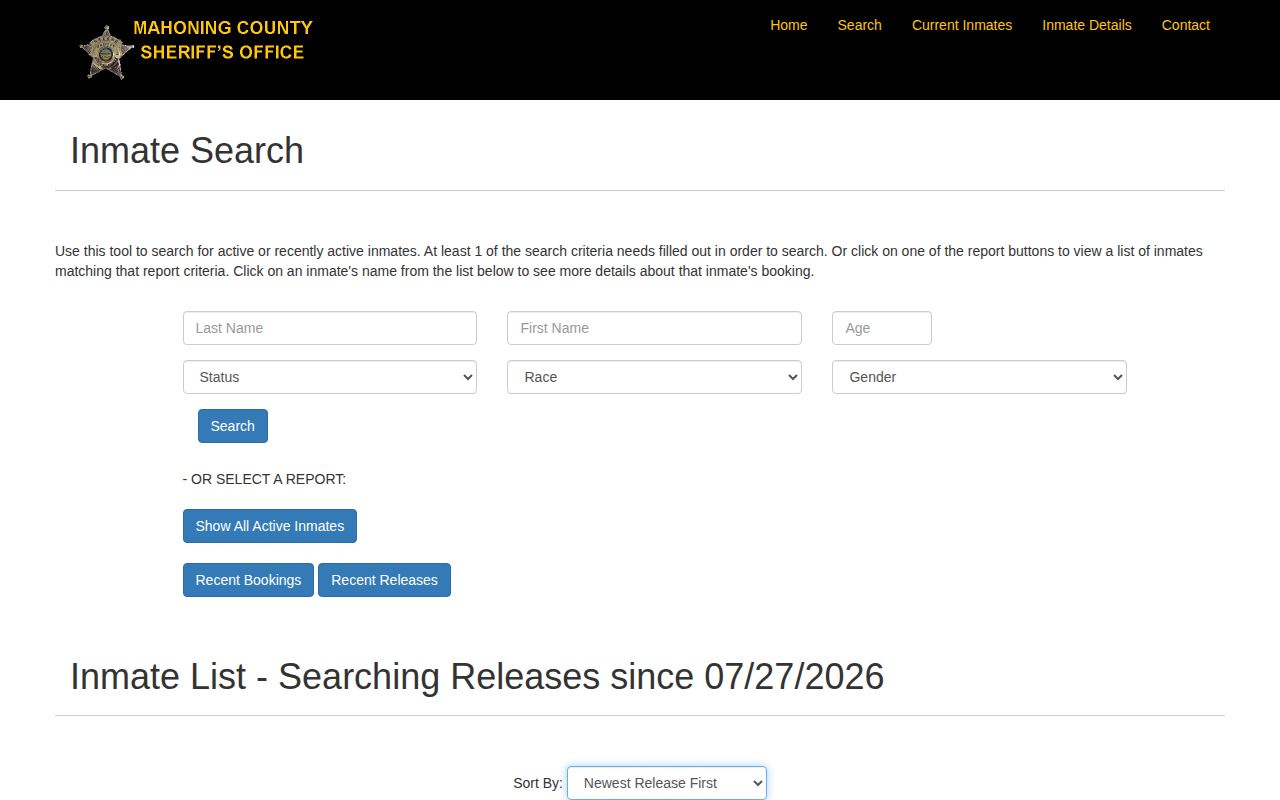
The screenshot demonstrates the discovery channel, but it is not an archival release certificate. A missing or broken image can resolve to a placeholder. Duplicate-looking cards have also appeared with the same inmate and booking facts but different image suffixes. Use booking number plus release date to identify one custody episode. Do not count cards or image files as separate releases.
This direct sheriff display is more reliable than beginning with an aggregator. Still, the card proves only that the listed local booking closed on the shown date. The photo documents the booking. Neither the image nor the arresting-agency label explains whether the person returned to the community, transferred, or remained under another authority.
Note: Save the booking number and release date promptly because the official card can age out of the short web window.
Mahoning Released Mugshot Sources
Photo sources must match the custodian. The county sheriff handles adult Justice Center booking images. ODRC handles public offender photos for qualifying state-prison or APA records. Courts explain the case and disposition, while news and third-party copies may preserve only a dated snapshot. VINELink can show identity or custody information in a participating record, but it should not be treated as a photo archive or release certificate.
| Channel | Has a photo? | How to access it |
|---|---|---|
| MCSO Recent Releases | Usually a booking image or placeholder | Open the official five-date report and match booking number plus release date. |
| MCSO Records Division | An existing booking photograph may be available | Request the named booking photo under Ohio public-record law, subject to lawful redaction or exclusion. |
| ODRC Offender Search | A state offender profile may display a photo | Search by offender number or name and verify the state record. |
| Official agency releases | Sometimes | Check a dated sheriff or police release and retain its original context. |
| Court docket | Not a dependable photo source | Use the docket mainly to confirm disposition, sealing, and release authority. |
| News or third-party pages | Sometimes a copied agency image | Treat it as a lead and recheck the booking and status through official sources. |
The source hierarchy reduces mismatches. Start with the public office that created or controls the record. Use a dated secondary copy only when the official channel no longer displays the photo, and never let an old image stand in for a current custody or case result.
Verify Mahoning Released Mugshots
A booking photo should be tied to one booking rather than to a name alone. Compare the inmate ID, booking number, booking date, and release date on the sheriff card. If the image uses a placeholder, the report still may confirm the booking fields, but it does not support a claim about the missing photograph. Ask Records Division for the existing image rather than stating it was deleted.
The sheriff's Inmate Information page separates Active Inmates, Recent Bookings, Recent Releases, and public inmate search options. The captured official menu below helps distinguish the released-booking photo route from the current-custody roster.
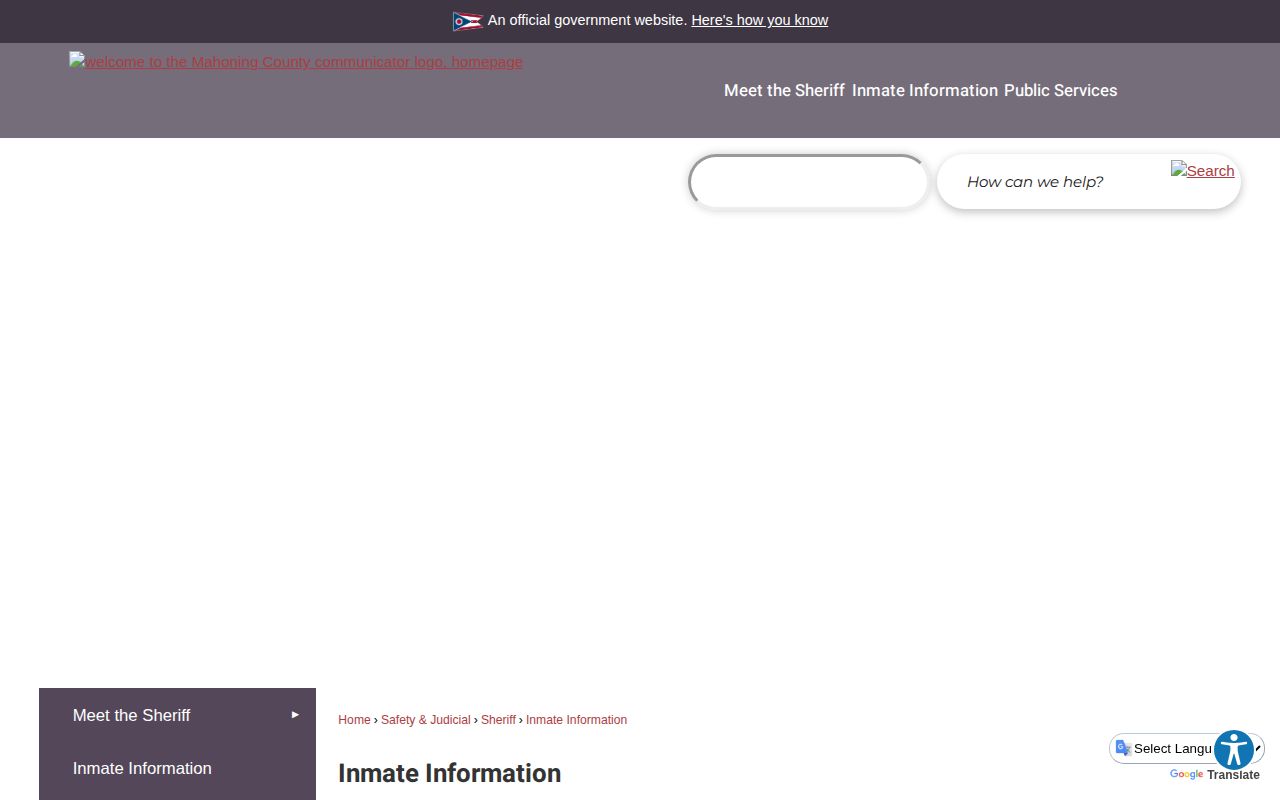
The menu points to the correct official report. Once a release card is gone, an active-roster search is not the archival fallback. Use the booking number with Records Division and the correct court docket.
A photograph does not establish guilt, the final disposition, present custody, or release destination. Read the corresponding docket for bond, dismissal, plea, sentence, commitment, judicial release, or another order. A bond release leaves the case pending. A prison commitment can close the local booking while state custody begins. The Mahoning County 24-hour release page explains how to focus the same official five-date report on the newest calendar entries without claiming an exact rolling-hour cutoff.
Request Mahoning Booking Photos
For an older Justice Center booking, call MCSO Records Division before sending a request or visiting. The official inmate page did not publish a sheriff-specific online request form, fixed photo fee, or guaranteed response time in the sources reviewed as of July 31, 2026. Ohio Revised Code 149.43 covers access to existing public records, subject to exemptions and lawful redactions. An office does not have to create a new photo or custom release certificate.
- Collect the full recorded name, inmate ID, booking number, booking date, and displayed release date. These facts identify the exact custody episode.
- Call Records Division at 330-480-5030. Confirm where to send the request and whether the existing booking photograph is held with the booking or release record.
- Ask for the existing booking photograph and associated booking and release or movement entry. Request electronic copies if that format is suitable.
- Ask for a cost estimate. Ohio law permits applicable copy or delivery charges, but no fixed MCSO amount should be invented.
- If material is withheld or redacted, ask the office to identify the legal basis and provide any nonexempt portion.
Juvenile, sealed, medical, victim, security, or other protected information may be excluded. Retention also varies by record series. The short life of a web card does not mean the underlying booking sheet, photograph, log, and other material all share one retention period. Name the record sought and consult the current MCSO retention schedule when timing matters.
A concise request can ask for the existing booking photograph for the named booking, plus the release date and movement disposition. The broader Mahoning County released inmate search explains how the release record and court docket work together when the photo alone cannot establish what happened next.
Note: Ohio generally measures inspection as prompt and copies within a reasonable period, not a guaranteed sheriff turnaround for every request.
ODRC Photos After State Release
A person who entered Ohio prison custody follows the statewide ODRC route. The ODRC Offender Search may display a public offender photo with the number, admission data, institution or supervising location, status, sentence fields, and release or supervision information. It is not a source for someone whose only custody episode was at the Mahoning County Justice Center.
Search with the offender number when possible. Otherwise compare name and record details with care. A profile can remain visible for a person under APA supervision or with a judicial-release or released status. Preserve the exact qualifier. A displayed photo identifies the ODRC record, while status and supervision fields explain the state custody event.
ODRC records are governed differently from sheriff booking records. Ohio Revised Code 5120.21 restricts some records concerning incarcerated people. A photo that ODRC chooses to display publicly does not establish access to the full institutional file or every identification image. For a specific state record, use the official ODRC public-record route and identify the offender number, docket, date range, and exact record sought.
Mahoning Mugshots Beyond Official Records
No official MCSO mobile-app link was found on the sheriff home page, inmate-information page, or public search interface during the research sweep. Do not substitute a vendor app or claim app-only photo access without current official confirmation. The sheriff website itself is Mahoning County's verified online booking-photo and recent-release channel.
Dated sheriff or police releases and social posts may preserve an arrest-era photo. Local news organizations may also retain an image supplied by an agency. Such material should keep its publication date and original context. It does not prove that a charge led to conviction, that a booking remains active, or that the pictured person has a present legal status. Confirm the booking and disposition through MCSO and the controlling court.
Third-party aggregators can be described as a discovery category, but no commercial mugshot or data-broker links belong in the search path. Copies may be stale, duplicated, attached to outdated allegations, or assigned to the wrong person. An apparent removal from one third-party page does not change the official court or booking record. Likewise, continued display elsewhere does not override a sealing order or an agency's access decision.
The safer practice is to record where the image originated and the date tied to it, then return to the public office. A copied photo without a booking number, date, or agency source has little value for confirming a released Mahoning County booking.
Match Mugshots to Mahoning Court Records
The Mahoning eCourts portal is mainly a case and disposition source, not a promised mugshot archive. Search by case number when possible and read the entries in order. Bond, dismissal, plea, sentence, jail-time credit, prison commitment, community control, judicial release, revocation, termination, and sealing entries answer different questions. None should be inferred from the photograph.
Mahoning has Common Pleas, geographic County Courts, and separate municipal jurisdiction. Start with the court named in the booking and the arrest location. One Common Pleas name search can miss the misdemeanor or preliminary docket that controlled the local release. An occasional court attachment might contain an image, but the docket should not be advertised as a dependable booking-photo channel.
If the booking photo and docket seem to concern different dates, compare booking and case numbers before merging them. One person may have several arrests or custody episodes. A later dismissal does not erase the fact that an earlier photo documented booking at that time, while a later sealing order can change public access to the case.
Mahoning Mugshot Sealing and Removal
Ohio sealing and expungement are governed by the current version of Ohio Revised Code Chapter 2953, including sections 2953.31 through 2953.36. Sealing restricts public access but does not necessarily destroy every government record. Expungement has a stronger statutory effect where authorized. Eligibility, exclusions, and timing depend on the disposition, offense, filing date, and law that applies to the case. No universal waiting period should be promised.
A court order is the key event. Once it takes effect, public case access may change, and a requester should not try to reconstruct or republish nonpublic material. Questions about an MCSO image should go to Records Division with the booking number and a copy or citation to the controlling order. Questions about the docket go to the clerk or court. A state-offender image follows ODRC's separate record rules.
No current Ohio mugshot-specific anti-pay-to-remove statute was verified in the official sources reviewed as of July 31, 2026. That narrow finding does not mean every commercial practice is lawful or that sealing, privacy, consumer-protection, court-order, and public-record limits cannot apply. Do not promise removal based on an unverified statute and do not endorse paid-removal services.
For process navigation, Ohio Legal Help's sealing information can explain general steps, but the current statute and the court's order control. Verify any change with the office that maintains the photo instead of assuming that removal from one search result removed every lawful copy.