
OSP Release Paths
Ohio State Penitentiary is operated by ODRC. Its prisoners are not part of the Mahoning County Justice Center population, even though both facilities are in Youngstown. The county sheriff's Recent Releases report therefore does not show an OSP discharge. State records follow the person through Ohio prison custody and, when applicable, Adult Parole Authority supervision.
A person can leave OSP because of an intrastate prison transfer, parole, post-release control, judicial release, or discharge. Parole is conditional release authorized for a Board-jurisdiction case. Post-release control is a period of state supervision that follows certain prison terms. Judicial release requires action by the sentencing court. Discharge means the record shows the applicable state status ended, but the exact qualifier must be preserved. ODRC can use released-status wording with qualifiers that do not mean a routine return to the community.
An institution change alone is not a release. It may show that ODRC moved the person to another Ohio prison while incarceration continued. Compare the former and current institution, status, admission and sentence information, actual supervision fields, and any release label. The sentencing journal entry helps resolve conflicts or missing context.
Confirm an OSP Release
The ODRC Offender Search is the correct first public route. It covers people currently in an Ohio prison, under DRC or APA supervision, or judicially released. It is not an archive of every person who spent time only in a county jail. Use an offender number whenever possible because names can collide and prefix matching can return longer names.
- Enter the full offender number, including its A, R, or W prefix and six digits. A five-digit female number needs a leading zero under ODRC instructions.
- If no number is known, search the full name. Use County of Commitment as a narrow filter, not as proof of residence.
- Open the matching detail and record the exact status, institution or supervising location, and date labels.
- Read the Expected Release Date/Parole Eligibility Date beside the sentence type, hearing fields, POA/PRD information, and supervision start.
- Confirm an apparent release with the sentencing court and ODRC Central Records when the public detail is incomplete or inconsistent.
The official form below shows the statewide search route used for Ohio State Penitentiary records.
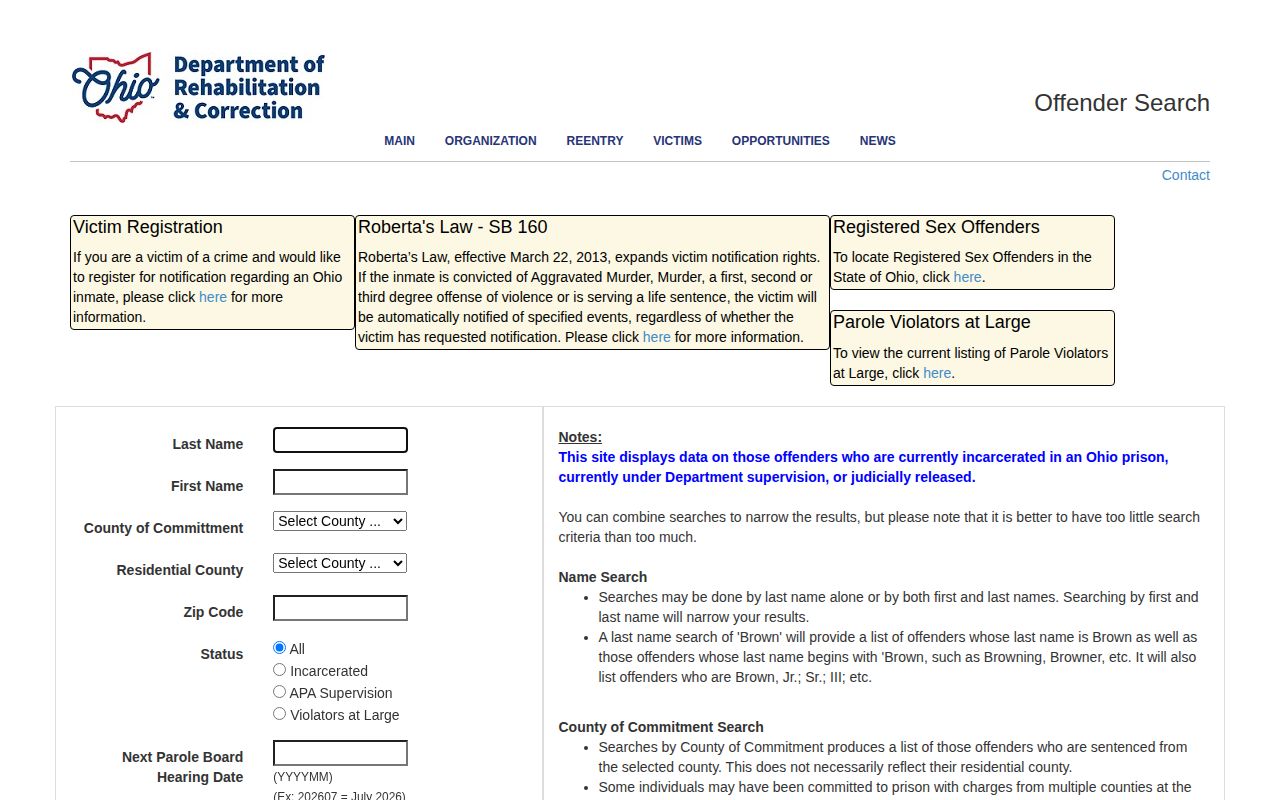
The form supports name, number, status, and other narrowing choices. Select the matching record carefully, then preserve the full field labels rather than turning every date into a projected release date.
Note: County of Commitment reflects the first listed committing county in ODRC data and does not necessarily show present residence.
OSP Release Status Fields
ODRC details can contain an offender photo and number, admission date, institution or supervising location, status, county, offense and sentence entries, docket, effective sentence date, jail-time credit, and supervision information. The fields vary with the sentence and status. A released person may retain a durable ODRC profile even after physical prison custody ends.
| ODRC field | How to read it |
|---|---|
| Status | Shows incarceration, APA supervision, released, judicial-release, or another displayed category and qualifier. |
| Institution or supervising location | Separates a prison placement from an APA office or other state location. |
| Expected Release Date/Parole Eligibility Date | May be a projection or an eligibility date, depending on the sentence. |
| POA/PRD Date | May show parole-on-or-after or projected-release information, not completed departure by itself. |
| Supervision Start Date | Supports that prison release into APA supervision occurred. |
| Hearing month and result | Show parole review activity, which can change and is not final physical release. |
An `APA SUPERVISION` status with a supervision start date is strong evidence that the person left prison under state supervision. It does not mean the sentence and every legal duty ended. A `RELEASED` label can carry a qualifier, including judicial release or another status. Preserve that qualifier. For questions about how Mahoning County records differ from state records, the Mahoning County release overview routes searches by custodian.
OSP Projected Versus Actual Release
ODRC's combined label, Expected Release Date/Parole Eligibility Date, must be read in context. In one case it may estimate the end of a term. In another, it may mark when discretionary parole can first be considered. Eligibility opens a decision process; it does not establish that the Parole Board approved release or that the person left OSP.
Ohio sentence calculations can involve definite terms, indefinite minimum and maximum terms, mandatory periods, jail-time credit, earned credit, judicial release, risk-reduction provisions, parole, and other rules. No fixed percentage applies to every OSP prisoner. Even a favorable hearing result can be reviewed or stopped before physical release. The actual status and supervision-start or release detail must be checked after the anticipated date.
- Expected date
- A forward-looking ODRC field that can move and may also represent parole eligibility.
- POA
- Parole on or after, a Board-related date that is not a completed release timestamp.
- PRD
- Projected release date, which remains subject to the person's sentence and current record.
- Supervision start
- The recorded beginning of APA oversight after prison release.
- Discharge
- An end status that should be stated with any qualifier displayed by ODRC.
The sentencing journal entry controls the imposed sentence, while ODRC administers the prison record. If the two appear inconsistent, send the offender number, docket, disputed field, and judgment entry to Central Records. Do not silently revise either official source.
OSP Release Under APA Supervision
Some people leave Ohio State Penitentiary and enter Adult Parole Authority supervision. ODRC detail may show a supervision start, period of supervision, APA office, and conditions. That record is a better confirmation of release from prison than a future eligibility date. It still describes conditional state oversight, not the end of all legal obligations.
The captured ODRC detail below illustrates how released or APA-supervision records can place status, sentence, and date information together. The source is the official ODRC offender detail.
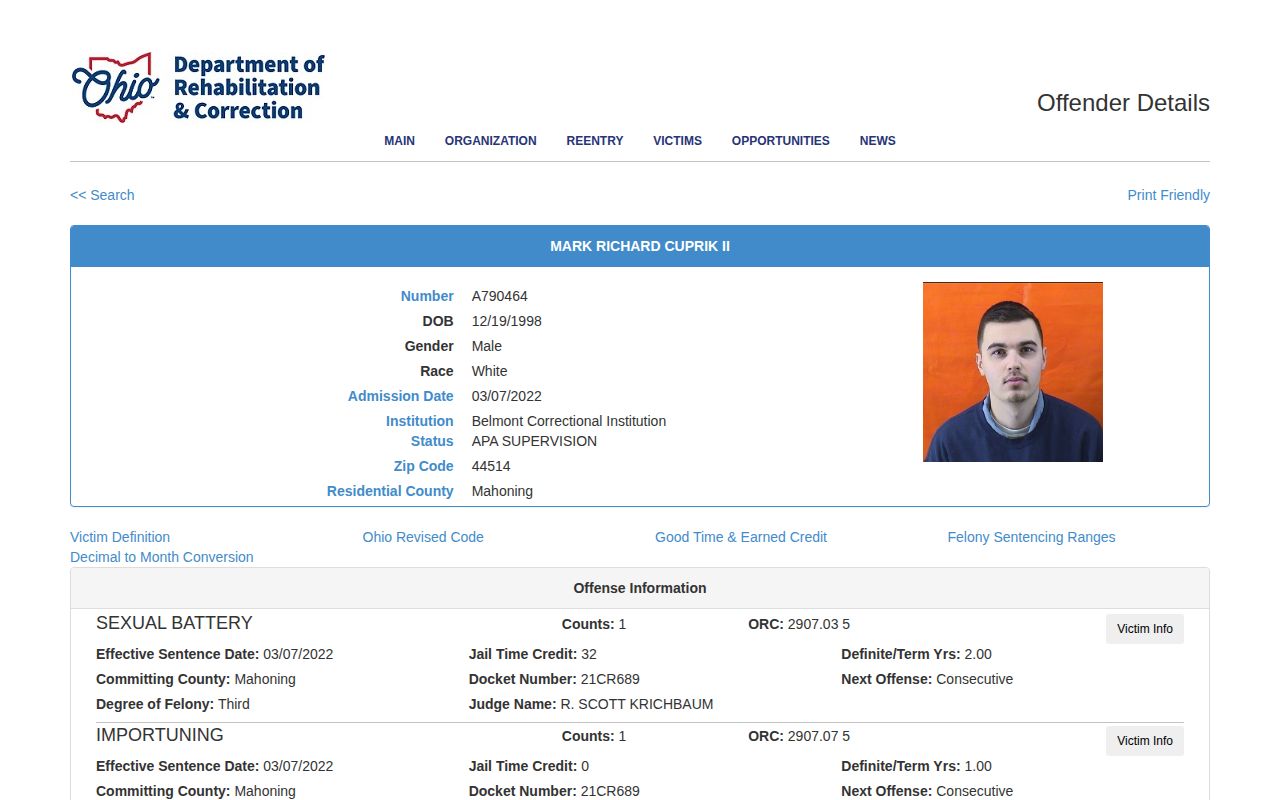
The image is an interface example, not a basis for conclusions beyond the displayed ODRC fields. A current lookup should use the person's own offender number and avoid collecting unrelated personal data.
Parole, post-release control, and probation are different. APA manages state parole and post-release-control cases. A Mahoning court manages community control or probation through the office named in its judgment. An APA office field is not proof of where the person lives. A Violator at Large address is the last address recorded before at-large status and must not be treated as a current location.
Note: A supervision start confirms a prison-to-APA transition more strongly than a forecast, but later discharge needs its own status or agency confirmation.
OSP Release Holds and Transfers
An OSP release date can be affected by a detainer, which is a request or legal basis for another authority to take custody. A person can finish one state custody event and move directly to a county, federal, or immigration authority. The ODRC record and sentencing docket may identify a hold or next movement, but the receiving custodian must confirm its own status.
Mahoning's adult jail report sometimes lists ICE or USMS as an arresting agency, and Youngstown also has a federal-contract facility. Those local facts do not turn an OSP movement into a sheriff release. If ODRC documents a federal transfer, follow the federal docket, USMS route, or BOP locator according to sentence stage. If immigration custody is documented, use ICE's Online Detainee Locator System and ERO instructions.
A transfer among ODRC institutions is simpler but still easy to misread. The institution name changes while the state prison status continues. Check whether the status remains incarcerated and whether another Ohio facility now appears. Do not describe the move as an Ohio State Penitentiary release to the community.
OSP Release Records and Contact
The official ODRC Ohio State Penitentiary page is the facility source. For a release or discharge discrepancy, ODRC Central Records is the research-supported records contact. Use the statewide ODRC public-records request route for an identifiable existing document. Include the offender number, docket, date range, and the specific movement or discharge record sought.
Ohio State Penitentiary
Operated by the Ohio Department of Rehabilitation and Correction
Youngstown, Ohio
ODRC Central Records
P.O. Box 430
Columbus, OH 43216
Ohio Revised Code 5120.21 restricts some records concerning incarcerated people. A photograph or field visible in public Offender Search does not create access to the full institutional file. Ask for the specific existing record and expect the office to apply any lawful restriction or redaction. If the question concerns the sentence itself, obtain the controlling judgment entry from the sentencing court as well.
Keep a clear source trail: offender number, ODRC status, exact label and date, institution or APA office, docket, and check date. That record lets Central Records identify the issue and helps distinguish release, supervision, judicial release, discharge, and transfer without guessing.