
Mahoning Projected Versus Actual Release
A projected date points forward. An actual release date records a completed movement. In an Ohio prison record, the exact combined label is “Expected Release Date/Parole Eligibility Date.” Depending on the sentence, it can mean a computed release point or the date when discretionary parole consideration becomes possible. It must be read beside status, sentence type, POA/PRD information, hearing results, jail-time credit, and supervision fields.
A Mahoning County Justice Center detainee awaiting trial normally has no computed sentence end. Bond, recognizance, dismissal, a later sentence, and other agency holds can change the outcome. Even a court order does not always equal the physical exit time because staff must process the movement and another detainer can remain.
Find Mahoning Projected Release Dates
The search route turns on the custodian. Use ODRC for a state prison sentence, the sentencing court and Justice Center records for a county jail sentence, and the federal record for a federal term. Do not apply ODRC prison fields to a jail-only booking.
- Identify the holding agency and collect the offender, inmate, booking, or case number.
- For an Ohio prison case, open the ODRC Offender Search and prefer the complete offender number.
- Read status, Expected Release Date/Parole Eligibility Date, POA/PRD, hearing month and result, sentence, and jail-time credit.
- For a county sentence, read the Mahoning judgment and ask Jail Administration or Records for the sentence computation and current holds.
- For a pretrial booking, follow the bond and court docket instead of seeking a sentence-end date.
- After the anticipated event, verify the actual release or transfer through the custodian.
The Mahoning County release search separates county, state, federal, and immigration confirmation when a movement replaces the expected date.
Ohio Earned Credit for Mahoning
ORC 2967.194 governs the current earned-credit framework beginning April 4, 2024. Eligible prisoners provisionally earn one or five days for each completed month of productive participation. The statute generally uses five days, while a specified older sexually oriented-offense category uses one. Successful completion of a second qualifying activity can add provisional days. Separate listed achievements can yield 90 days or ten percent of the stated term, whichever is less and subject to the law.
The ordinary participation and completion mechanism has an aggregate 15 percent cap. Credits can be withheld or withdrawn for violations and become final after administrative review. Mandatory or nonreducible terms and several offense or sentence categories are excluded. Historical ORC 2967.193 applies only through April 3, 2024 and should not be quoted as the current rule.
No release estimate should be made from the cap alone. The individual ODRC record, sentence date, offense, court judgment, and applicable statutory version control.
Why Mahoning Release Dates Change
A displayed date is the product of a legal term and the agency's current computation. Later events can change either the calculation or what occurs when that term ends.
| Factor | Possible effect | Record to check |
|---|---|---|
| Earned credit | May reduce a qualifying term within statutory limits | ODRC computation |
| Credit withdrawal | Can move the date later after review | ODRC administrative record |
| Jail-time credit | Credits qualifying prior confinement | Judgment and sentence detail |
| Detainer or hold | Can cause transfer or continued custody | Movement record and receiving authority |
| Court order | May alter or authorize release | Signed journal entry |
| Parole result | May continue, defer, recommend, or stop release | Board result plus later status |
| Indefinite-term hearing | May continue custody beyond the minimum | Hearing record and imposed maximum |
Transfers require special care. A Mahoning jail release date can be correct even when the person enters ODRC, ICE, federal, or another county's custody the same day.
Confirm Mahoning Actual Release Dates
ODRC may show a released status, an APA Supervision status with Supervision Start Date, or a release qualifier such as judicial release. Preserve the agency's exact wording. For a Justice Center booking, use the sheriff's release card and underlying movement record. For either path, compare the court judgment when the authority or date is unclear.
VINELink can provide a forward-looking custody alert from a participating source. Register on the correct person record, then confirm the event after an alert. The Mahoning VINELink inmate check explains search matching, notification methods, and the telephone PIN. VINE is not an archival release certificate, and silence does not prove custody stayed unchanged.
The official ODRC form in the manifest shows where the state search starts.
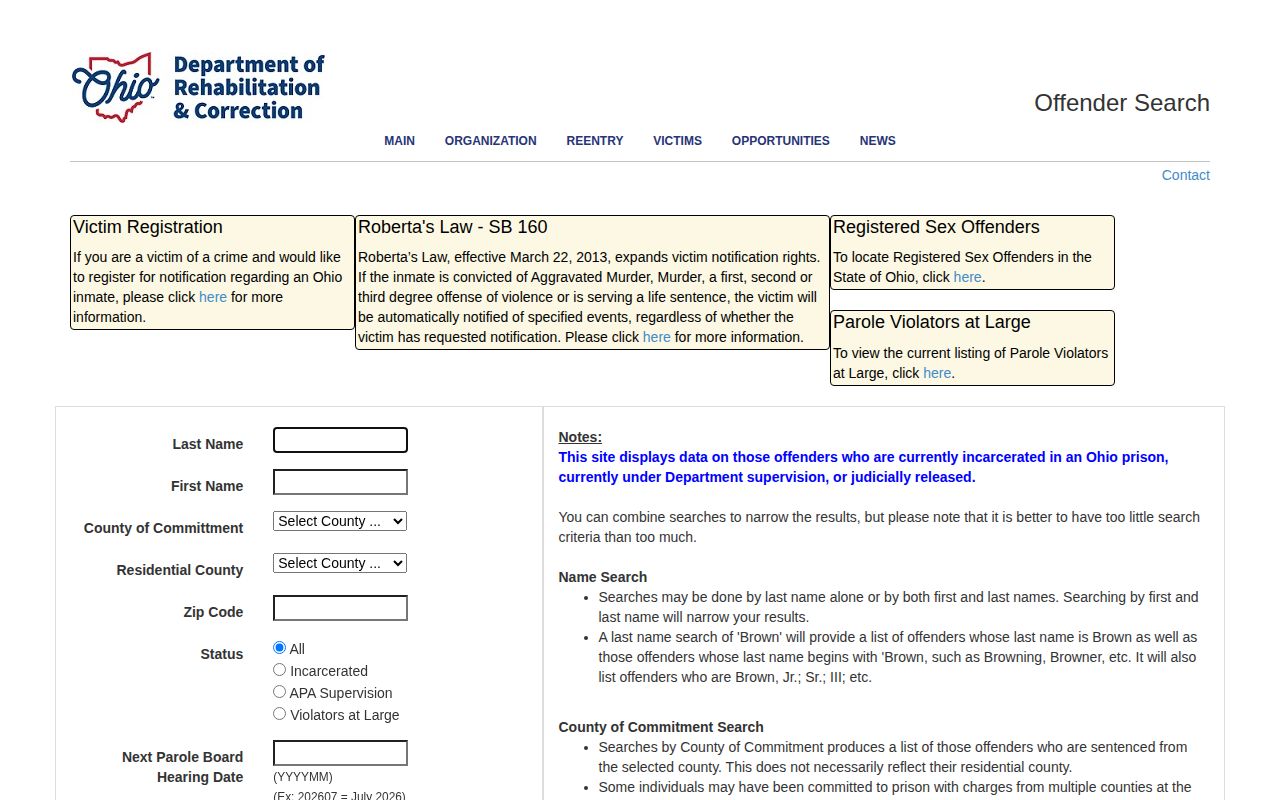
Open the detailed result and transcribe the displayed label rather than replacing every date with “projected release.”
Ohio's 85 Percent Release Myth
The common claim that every Ohio inmate serves 85 percent of a sentence is unsafe. Fifteen percent is a cap for one ordinary credit mechanism. Mandatory terms, excluded offenses, jail-time credit, separate completion credit, judicial release, risk-reduction release, transitional control, discretionary parole, and indefinite-sentence hearings follow different rules. The same percentage cannot resolve them all.
ORC 5120.036 provides a distinct risk-reduction sentence path that can involve release after mandatory terms and at least 80 percent of aggregated nonmandatory terms when statutory programming and criteria are met. Judicial release under ORC 2929.20 requires sentencing-court action. Neither belongs in a simple good-time calculation.
Note: Use the statute and the individual ODRC field, never an unsourced percentage calculator for a Mahoning release date.
Mahoning Reagan Tokes Release Dates
Qualifying non-life first- and second-degree felony sentences can use the Reagan Tokes minimum and maximum structure under ORC 2929.14. ORC 2967.271 creates a presumption of release at the minimum expiration or presumptive earned-early-release date. ODRC may rebut that presumption after a hearing and continue confinement, but not beyond the imposed maximum.
The director may also recommend a statutory minimum reduction for exceptional conduct and adjustment, with the court deciding through the required process. That is why a single expected date can move. Read the minimum, maximum, hearing record, status, and final release event together. A future minimum is not an actual departure date.
Mahoning Parole Eligibility Dates
ORC 2967.13 sets offense- and sentence-specific eligibility points, especially for life terms. Many “full years” in that law are not reduced by earned credit. Older indefinite and life cases remain discretionary. Eligibility only opens consideration by the Parole Board.
ODRC detail may show the next hearing or review month, latest result, and a POA/PRD date. POA means parole on or after, while PRD means projected release date. A favorable result can still receive review, deferral, or rescission before physical release. Confirm the later released or APA-supervision status and supervision start rather than reporting the eligibility field as a completed event.
Mahoning Jail Release Calculation
A county sentence follows the journal entry, jail-time credit, applicable jail rules, and any other hold. No Mahoning-specific public good-days formula, weekend-release rule, or fixed release-time policy was located in the official sources reviewed. ODRC prison credit must not be applied automatically to a Justice Center sentence.
When exact timing matters, obtain the sentence computation or release record from Jail Administration or Records Division. Give the booking and case numbers, judgment date, displayed release information, and any known hold. The court explains the sentence. The sheriff confirms the physical county movement. Another custodian must confirm a transfer.
Mahoning Release Date Field Meanings
Several labels can appear on the same Ohio record, and each has a narrower meaning. Expected Release Date/Parole Eligibility Date is a combined forward-looking field. POA means parole on or after. PRD means projected release date. Next Parole Board Hearing/Review Month schedules consideration. Latest Parole Board Hearing/Review Type and Results describes the recorded outcome. Supervision Start Date can show when community supervision began.
- Jail-time credit
- Qualifying prior confinement credited against the sentence.
- Definite term
- A sentence with a stated length rather than a discretionary old-law range.
- Minimum term
- The first release point in a qualifying indefinite structure, subject to legal process.
- Maximum term
- The outer term imposed for that indefinite sentence.
- Detainer
- An authority's hold that can change the destination when one custody term ends.
Never isolate a date from the status and sentence. A future parole eligibility date does not show that the Board granted release. A supervision start can support that prison custody ended, but it does not prove that the full sentence or supervision term was discharged.
Correct Mahoning Release Date Conflicts
ODRC warns that the online record may not contain complete sentencing information. When the offender detail and judgment appear to conflict, preserve both sources and contact ODRC Central Records at P.O. Box 430, Columbus, OH 43216. Include the offender number, docket, disputed label, check date, and a copy of the controlling judgment entry. Do not silently replace an official field with a private calculation.
County conflicts follow the same principle. A court order records legal authority, while the Justice Center movement record captures operational release or transfer. A date-only public card cannot establish an exact hour. Ask Records Division for the existing movement entry and any public receiving-agency field. If a new custodian took control, continue the check in that agency's locator.
A screenshot can preserve what an online system displayed on a given day, but it is not a certified sentence or movement record. Save the label, offender or booking number, displayed date, status, and access date. If ODRC later changes a projected field, compare the current detail with the judgment and any agency response. If the sheriff's short release card ages off, use the booking number to request the underlying release record instead of inferring a date from roster absence.
Federal and immigration dates remain custodian-specific. A BOP release date means BOP custody ended, while an ICE locator result concerns present immigration detention and is not a historical release archive. Neither record supplies the Mahoning sheriff's movement time. When one custody system hands a person to another, both the first agency's release date and the next agency's intake date can be accurate. Describe the transfer instead of choosing one date as universal.