
CCA Release and Placement Meaning
Community Corrections Association is a local nonprofit that provides community-corrections and residential programming in Youngstown. Its role differs from the Mahoning County Justice Center, Ohio State Penitentiary, and Northeast Ohio Correctional Center. A participant may arrive through a court order, community-control plan, corrections transition, or reentry arrangement. The source and terms of that placement determine which agency can confirm its beginning and end.
“Released to CCA” can be misleading. Movement from jail to a residential program may close a sheriff booking, yet the person can remain under a court order. Movement from an Ohio prison may be transitional control, parole, or post-release control managed by the Adult Parole Authority. Likewise, completion of a CCA residential phase does not automatically discharge the sentence or all supervision. Use “placed,” “transferred,” or “left the program” until the governing record supports full discharge.
Find a Court-Ordered CCA Release
The Mahoning County eCourt portal is the durable public starting point for many local placements. Search by case number when available, since names can collide. Read docket entries in date order. Look for the judgment, community-control terms, placement language, later modifications, violation hearings, revocation, and termination. A placement entry shows authority to enter a program. It does not by itself show the exact time the person arrived or departed.
- Identify the court named in the booking, judgment, or placement paperwork.
- Search the correct docket with the case number and recorded identity.
- Read the judgment and each later entry for CCA, residential, treatment, or community-control terms.
- Contact the probation department named in the judgment when the public entry does not show present status.
- Ask CCA only for program facts it is authorized to disclose.
The official eCourt interface shown below supports the court-record portion of this check. Open the current Mahoning eCourt search before relying on a saved result.
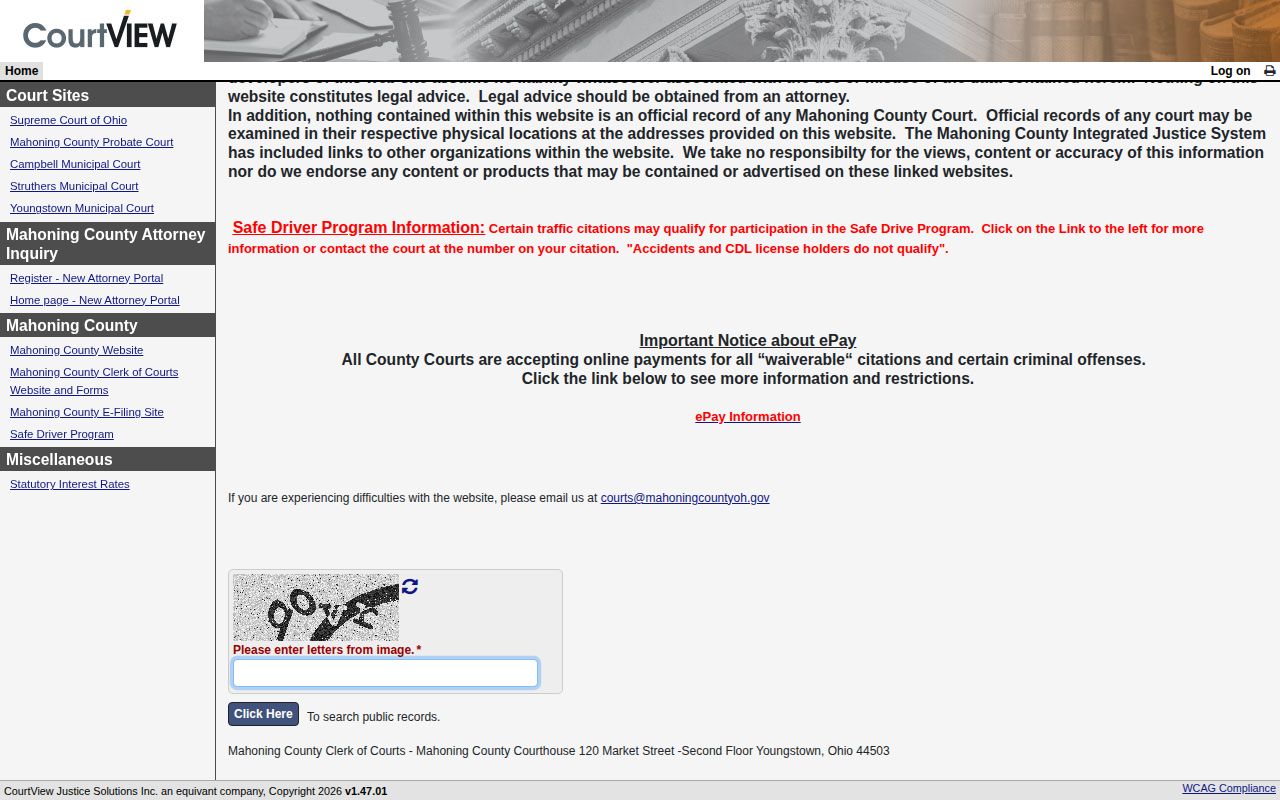
A court entry can explain why county custody ended and whether supervision continued. It still may not record the exact physical movement time, so compare it with the sheriff movement record or an authorized program response when timing matters.
Route Mahoning CCA Court Records
Mahoning County has several possible court paths. County Courts #2 through #5 serve different geographic divisions. Common Pleas handles felony matters and other cases within its jurisdiction, while municipal courts have separate local authority. A single name search in one court can miss the docket that controls a CCA placement. Start with the court listed on the booking record and consider the arrest location.
The county's official court list helps identify the proper division. The Mahoning County Clerk of Courts can route Common Pleas record questions. County Court Probation Services publishes information for reporting and non-reporting community control, but Common Pleas or municipal probation may be separate. Use the department named in the actual judgment.
- Community control
- A court sanction served in the community under stated terms, often called probation.
- Residential placement
- A required stay in a program setting that may continue legal control outside jail.
- Revocation
- A court action that can end community placement and impose a new custody response.
- Termination
- An order ending supervision or a program term when the record expressly says so.
Note: A docket disposition can close one count while another case, hold, or supervision order remains active.
Verify an ODRC CCA Release
When CCA placement follows an Ohio prison term, search the ODRC Offender Search by offender number. Read the full status with the supervision fields. “APA SUPERVISION” plus a supervision start date supports that the person left prison under state control. It does not mean the sentence and all duties ended. The detail may also show period of supervision, APA office, and conditions.
Transitional control requires special care. Under Ohio law, an eligible person may spend a final part of confinement in a licensed halfway house or approved residence while retaining inmate status. A move from prison to such a setting is not final discharge. Parole and post-release control also impose supervision after physical prison release, though their legal bases differ. Preserve the exact ODRC label rather than converting each path into “free.”
If ODRC and the court record conflict, use the offender number and docket to ask the responsible office for clarification. A future expected-release or parole-eligibility date is not proof that the person left custody. A supervision start is stronger evidence of physical prison release, but a later discharge must be shown by an updated agency status or record.
CCA After a County Release
A Mahoning County Justice Center booking may close when a person moves to a court-ordered CCA placement. The sheriff's short Recent Releases report can show the person's name, inmate ID, booking number, booking date, arresting agency, and release date. Those fields prove the local booking ended. They do not publish the release reason or destination on the summary card.
Open the booking detail and controlling docket. A community-control or placement order can support the CCA destination. If it remains unclear, give Mahoning County Records Division the name, inmate ID, booking number, booking date, and displayed release date. Ask for the movement disposition, release time, and receiving placement if public. Do not infer a CCA placement from roster absence alone.
| Record | What it proves | What it does not prove |
|---|---|---|
| Sheriff release date | The local booking closed | Full discharge or destination |
| Court placement order | Legal authority and terms | Exact physical arrival time |
| CCA exit information | Program departure if disclosed | End of all supervision |
| ODRC status | State custody or APA status | A county-only court status |
CCA Release Records and Contact
CCA's official website is the direct program-navigation source. Because the research does not provide one universal public records address, telephone number, or public roster for all CCA facilities and programs, use the current contact shown by CCA for the specific program. Ask whether the office can confirm participation or exit information and what authorization is required. Do not expect disclosure of protected treatment or case details.
Community Corrections AssociationYoungstown, Ohio
Community-corrections and residential programs
Current program and contact information
For a court order, contact the assigned probation office or clerk. Mahoning County Court Probation Services publishes 330-740-2196, but that office may not control a Common Pleas or municipal case. For ODRC supervision, follow the APA office on the offender detail. For the county booking movement, use MCSO Records Division. Each contact addresses only its own record.
The Mahoning County release-record search supplies the county-booking and custodian decision path when the source of a CCA placement is not yet known. Once identified, stay with the court or agency that imposed the placement.
Note: Program privacy limits are not proof that a person is present, absent, released, or discharged.
Confirm the CCA Release Outcome
A sound conclusion separates four events: county booking closure, entry into CCA, exit from CCA, and termination of legal supervision. They may happen on different dates. Record the case, offender, or booking number attached to each event. Then preserve the exact court or agency wording. “Placed at CCA” is not “sentence discharged.” “Left CCA” is not “off supervision” unless a court or ODRC record says so.
When records disagree, report the mismatch and seek the record creator. The sheriff owns its booking movement. The court owns its journal entry. ODRC and APA own state supervision status. CCA owns program records subject to its authority and disclosure rules. The final statement should identify which event was confirmed, by which source, and on what check date.
Public Record Search
Sponsored Results