
Mahoning Parole Versus Probation
Parole is conditional release from an Ohio prison for cases within Parole Board authority. Post-release control is a separate state supervision term that follows qualifying prison sentences. Both are administered through the Ohio Department of Rehabilitation and Correction's Adult Parole Authority, or APA. Probation and community control are imposed by a court, often instead of a prison term, and remain with the department named in the judgment. A person who posts bond is in a pretrial status and is not placed on probation merely because the jail booking ended.
| Status | Who orders it | Mahoning verification route |
|---|---|---|
| Parole | Ohio Parole Board | ODRC offender detail, hearing result, and APA fields |
| Post-release control | Ohio sentence and statute | ODRC status, supervision start, period, office, and judgment |
| Probation or community control | Sentencing court | Mahoning docket and assigned probation department |
| Bond release | Court before disposition | Bond order and booking release, not a supervision record |
- Parole
- Board-authorized conditional release from prison.
- Community control
- Ohio court supervision that is often called probation.
- Post-release control
- APA supervision that follows a qualifying prison term.
- Discharge
- The official end of the stated supervision term.
Verify Mahoning Post-Release Supervision
Start with the source tied to the sentence. State supervision appears in the ODRC Offender Search. Local court supervision appears in the controlling docket and may require contact with that court's probation unit. Mahoning County Court Probation Services does not handle every Common Pleas or municipal case, so the journal entry is the routing document.
- Identify whether release followed a state prison sentence, county court sentence, or bond order.
- For ODRC, search by full offender number when available and open the matching detail.
- Read status, Supervision Start Date, Period of Supervision, APA Offices, and Conditions of Supervision together.
- For court probation, find the judgment in the correct Mahoning court and note the assigned department.
- Look for later violation, revocation, termination, or discharge entries.
- Ask the named office to resolve conflicts while respecting limits on personal reporting details.
An ODRC supervision start is stronger proof of physical prison release than a projected date. Still, it proves only that supervision began. A later discharge requires its own status update or record. The full county release trail is explained on the Mahoning County released inmates search.
Mahoning Supervision Office Routes
A state offender detail may name Youngstown APA unit one, two, or three. That field routes the case within ODRC. It should not be treated as the person's home address or proof of where reporting occurs today. The research found an older state facility document placing Youngstown APA operations at 242 West Federal Street, Suite 402, but official directions should be checked with ODRC before travel because directories change.
Mahoning County Court Probation ServicesPhone: 330-740-2196
Fax: 330-792-3362
Use only when the judgment assigns that department. Ohio Parole Board
4545 Fisher Road, Suite D
Columbus, OH 43228
614-752-1200 or 888-344-1441
Fax: 614-752-0600
The county probation page describes reporting and non-reporting community control and individualized conditions. A Common Pleas or municipal judgment may point elsewhere. For state cases, use ODRC APA field services and the office shown in the offender record.
Mahoning Violations and Absconders
Conditions depend on the judgment, supervision type, and individual order. A court docket may refer to reporting or non-reporting community control, electronic monitoring, treatment, or another term. APA conditions appear in the ODRC detail. Neither a generic list nor the existence of an APA office can establish the current requirements for one person.
The ODRC Violators at Large filter is an absconder path. An absconder is a supervised person whom the agency reports as no longer complying with contact requirements. Under ORC 2967.15, APA may declare and retake a violator within the statute's terms. ODRC warns that a residential address shown on a VAL record is the last recorded address before at-large status. It is not a known current location and should never be presented as one.
A county warrant and an APA violation can involve separate authorities. Check each source rather than merging them into one event. A violation can lead to a hearing, sanction, or return to custody, but it does not erase the fact that an earlier physical release occurred.
The Ohio sex-offender registry is a separate system for people with a registration duty under ORC Chapter 2950. A registry entry is not proof of parole, probation, or current custody. Verify supervision only through APA or the assigned court.
Mahoning Supervision Discharge Records
Release from confinement and discharge from supervision are distinct milestones. For APA, look for a later ODRC status or agency confirmation that the term ended. For probation or community control, the court may enter a termination, completion, revocation, or discharge order. A supervision start date and stated period can guide the search, but they do not replace the final record because warrants, violations, court changes, or other events may affect the term.
Parole eligibility is also not discharge. ORC 2967.13 supplies offense-specific eligibility rules. A favorable recommendation can still undergo review, and ODRC guidance states that release decisions are not final until physical release. After departure, read the supervision fields. After the stated term, seek the discharge record.
Note: Preserve the offender or case number, source, displayed status, and check date when documenting the end of Mahoning supervision.
Mahoning Parole Hearing Records
ODRC's public search supports a monthly hearing workflow. Enter the Next Parole Board Hearing Date as a six-digit year and month, or search the person and open the detail. The record can show the next hearing or review month and Latest Parole Board Hearing/Review Type and Results. A month is a schedule aid, not a promise that the date cannot change.
The Ohio Parole Board publishes official board resources. When a separate schedule or decision page is reorganized or incomplete, the individual ODRC detail is the first public result route, and official minutes may be requested. Outcomes must be described with the recorded wording, such as recommendation, denial and continuance, deferral, or rescission. Eligibility opens consideration. It does not establish suitability or physical release.
The successful manifest capture shows a released or APA-supervision detail where the status and sentence fields must be read together.
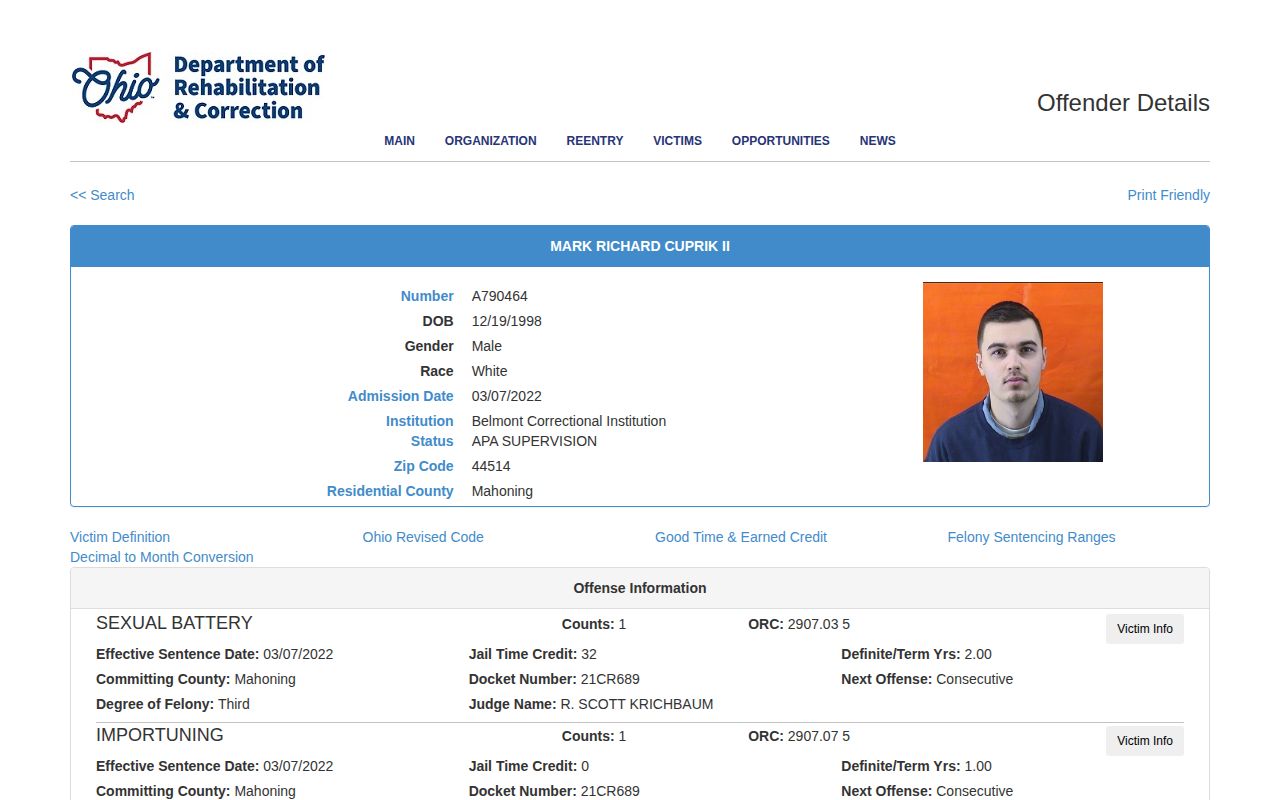
Check the supervision start after a favorable result. That later field is the stronger signal that prison custody actually ended.
Property After Mahoning Release
The 2025 Mahoning County jail handbook tells a person leaving the Justice Center to verify property before signing the receipt. Missing items should be reported to a deputy then. When property belongs to a transferred person, advance designation and photo identification are required for pickup. The handbook gives a 30-day claim period for property left after release or transfer before abandonment and disposal treatment applies.
This deadline can matter even when the person moves directly into APA supervision, court community control, or another placement. It is a jail property rule, not a statement that all legal control ended. Keep the signed receipt and call Jail Administration at 330-480-4920 for current pickup directions. A supervising officer does not replace the sheriff's property process.
Mahoning Transitional Control Status
Transitional control creates another important distinction. Under Ohio law, an eligible person can move from prison to a licensed halfway house or approved residence for the final part of a term, sometimes with electronic monitoring. The person can be outside a prison gate while remaining in inmate status. That movement should not be described as sentence discharge or ordinary parole merely because the institution field changes.
Read the ODRC status, placement, sentence, and APA fields together. If the record identifies transitional control, keep that exact term. The supervising or placement office can confirm the current authority within lawful disclosure limits. A later supervision start or discharge date answers a different question and must be recorded separately.